Accepting Donations!

Donate to a worthy cause!

Please please please?

Ask The Oculatum

Enter your question and receive the wisdom of the Occulatum. You may pose your question in any way that feels appropriate. The answer will come in the form of a small pop up. Try it - your life just might change for the better!

This script brought to you by JAVAFILE.COM

Cool Quote

  • Lives are snowflakes - “Lives are snowflakes - forming patterns we have seen before, as like one another as peas in a pod (and have you ever looked at peas in a pod? I mean, real...

Support This Site

Shop Amazon through this link, and support this site. Thanks!!

Recent Comments

Powered by Blogger Tutorials

Visitors

Facebook Fans

AddThis Feed Button

Showing posts with label procrastination. Show all posts

The Scoop On Procrastination

Tuesday, March 30, 2010

I thought it might be good to explore the subject of procrastination today. I find that even though I'm managing to meet my commitment every day, I'm often waiting until the very last minute to do it.

So, From Wikipedia, we have this wonderful article on Procrastination, what it means, why we do it, and even the different types of procrastinators.
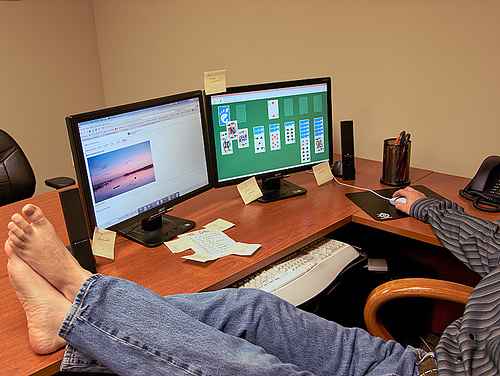

Procrastination refers to the counterproductive deferment of actions or tasks to a later time. Psychologists often cite such behavior as a mechanism for coping with the anxiety associated with starting or completing any task or decision. There are three criteria for a behavior to be classified as procrastination,it must be:

  1. Counterproductive
  2. Needless
  3. Delaying

(This sounds alot like that silly facebook game I got hooked on a while back... what about you guys? Anyone else have a game on facebook (or elsewhere) that is counterproductive, needless, and delaying?)

Procrastination may result in stress, a sense of guilt and crisis, severe loss of personal productivity, as well as societal disapproval for not meeting responsibilities or commitments. These feelings combined may promote further procrastination. While it is regarded as normal for people to procrastinate to some degree, it becomes a problem when it impedes normal functioning. Chronic procrastination may be a sign of an underlying psychological disorder.

Etymology:
The word itself comes from the Latin word procrastinatus: pro- (forward) and crastinus (of tomorrow). The term's first known appearance was in Edward Hall's The Union of the Noble and Illustre Famelies of Lancastre and York, first published sometime before 1548. The sermon reflected procrastination's connection at the time to task avoidance or delay, volition or will, and sin.

(So, before 1548 no one was a procrastinator... they (we) were all sluggards. Personally I like the word procrastinator better than sluggard. It sounds more... I dunno... more professional and less lazy!)

Causes of procrastination:

  1. Psychological
    The psychological causes of procrastination vary greatly, but generally surround issues of anxiety, low sense of self-worth, and a self-defeating mentality. Procrastinators are also thought to have a lower-than-normal level of conscientiousness, more based on the "dreams and wishes" of perfection or achievement in contrast to a realistic appreciation of their obligations and potential.

    (I'll bet that this lower-than-normal level of conscientiousness can be directly linked to habitually breaking commitments made to oneself. I wonder which came first, the anxiety, low self esteem, and defeatism - or the not keeping of the commitments.)

  2. Physiological
    Research on the physiological roots of procrastination mostly surrounds the role of the prefrontal cortex. This area of the brain is responsible for executive brain functions such as planning, impulse control, attention, and acts as a filter by decreasing distracting stimuli from other brain regions. Damage or low activation in this area can reduce an individual's ability to filter out distracting stimuli, ultimately resulting in poorer organization, a loss of attention and increased procrastination.

    Procrastination can be a persistent and debilitating disorder in some people, causing significant psychological disability and dysfunction. These individuals may actually be suffering from an underlying mental health problem such as depression or ADHD.

    (Does it annoy anyone else that nowadays every problem under the sun is a "psychological disorder" or "mental illness?" On the other hand, "mental defect" or "character flaw" don't sound any better. Maybe I just don't want to think there's anything wrong with me ...)

Procrastination and mental health
While procrastination is a behavioral condition, these underlying mental health disorders can be treated with medication and/or therapy. Therapy can be a useful tool in helping an individual learn new behaviors, overcome fears and anxieties, and achieve an improved quality of life. Thus it is important for people who chronically struggle with debilitating procrastination to see a trained therapist or psychiatrist to see if an underlying mental health issue may be present.

People who exhibit procrastination and decreased impulse control appear to be prone to internet addiction.

(ok... so that's something to think about, and it's interesting because it occurs to me that the internet might be a procrastinators paradise! I mean, where else can a person spend so much time "seemingly" doing something, when in actuality, you're just goofing off. I personally love the internet... and while some of what I do is actually productive and necessary - a fair amount of time is spent just fiddling around. And for me, facebook is the ultimate distraction. What about you guys? do you find facebook addictive? or are there other places on the net that suck you in?)

Perfectionism:
Traditionally, procrastination has been associated with perfectionism, a tendency to negatively evaluate outcomes and one's own performance, intense fear and avoidance of evaluation of one's abilities by others, heightened social self-consciousness and anxiety, recurrent low mood, and "workaholism". According to Robert B. Slaney adaptive perfectionists (when perfectionism is egosyntonic) were less likely to procrastinate than non-perfectionists, while maladaptive perfectionists (people who saw their perfectionism as a problem; i.e., when perfectionism is egodystonic) had high levels of procrastination (and also of anxiety).

(Ok... yeah... perfectionist.. that's me. Sometimes perfectionism is a plus, but some of us take it to extremes... extremists that we are... and then.. well... it causes the sin of procrastination! At least that's what I'm thinking. Anybody else have thoughts on this one?)

Types of procrastinators

  1. The relaxed type
    The relaxed type of procrastinators view their responsibilities negatively and avoid them by directing energy into other tasks. It is common, for example, for relaxed type procrastinating children to abandon schoolwork but not their social lives. Students often see projects as a whole rather than breaking them into smaller parts. This type of procrastination is a form of denial or cover-up; therefore, typically no help is being sought. Furthermore, they are also unable to defer gratification. The procrastinator avoids situations that would cause displeasure, indulging instead in more enjoyable activities.

    In Freudian terms, such procrastinators refuse to renounce the pleasure principle, instead sacrificing the reality principle. They may not appear to be worried about work and deadlines, but this is simply an evasion of the work that needs to be completed.

  2. The tense-afraid type
    The tense-afraid type of procrastinators usually feel overwhelmed with pressure, unrealistic about time, uncertain about goals, and many other negative feelings. They may feel a sense of malaise. Feeling that they lack the ability or focus to successfully complete their work, they tell themselves that they need to unwind and relax, that it's better to take it easy for the afternoon, for example, and start afresh in the morning. They usually have grandiose plans that aren't realistic. Their 'relaxing' is often temporary and ineffective, and leads to even more stress as time runs out, deadlines approach and the person feels increasingly guilty and apprehensive.

    This behavior becomes a cycle of failure and delay, as plans and goals are put off, pencilled into the following day or week in the diary again and again. It can also have a debilitating effect on their personal lives and relationships. Since they are uncertain about their goals, they often feel awkward with people who appear confident and goal-oriented, which can lead to depression. Tense-afraid procrastinators often withdraw from social life, avoiding contact even with close friends.

    (When it comes to procrastination, which type are you?

    I think I'm a pretty good blend of both! More the first than the second, but I do definitely see myself in that second role of constantly wanting to unwind and relax right now, thinking I'll start "fresh" in some perfect future moment. I do love that phrase about "refusing to renounce the pleasure principle, and instead sacrificing the reality principle." It's interesting, since I don't find myself experiencing much pleasure... instead, it's mostly pressure.)


So there we have it guys! The scoop on procrastination complete with commentary. And how are we doing with our daily commitments? Anyone else got the procrastination bug? Or is it just me? If I'm not the only one, and if you've got it bad, here's a link to Procrastination Central. There might be something there you can use. And if it works for you, let me know. I need all the help I can get!

Are You Procrastinating?

Friday, May 29, 2009

Nothing is so fatiguing as the eternal hanging on of an uncompleted task.
~William James


Procrastination


Many of my most difficult energy drains are caused by my talent for procrastination. For example, I still have not filed my Missouri Income Tax which was due April 15. It just sort of hangs there, over my head, along with a zillion other things I routinely schedule for "tomorrow."

Which reminds me of an old Spanish proverb: Tomorrow is often the busiest day of the week. So true. There is, however, this other quote by Pablo Picasso: Only put off until tomorrow what you are willing to die having left undone.

Ok.. that makes it a little easier... I'm perfectly willing to die having left my taxes unfiled! So, HA! I'm off the hook on that one! And, actually, I can't think of a single task that I have put off doing that I wouldn't be perfectly happy to leave undone forever! So there!! My procrastination issues have now been resolved. I'm quite content to die leaving a pretty big mess for everyone else to clean up... which doesn't sound very enlightened, or very considerate, or even very nice.

So... I suppose it might be a good day to do at least one thing that I've been putting off. Hmmm... so many tasks... so little time... what will I choose... And what about you? Are you procrastinating something? several somethings? Maybe today would be a good day to get at least one of them done, don't you think?

Here's some good advice:

For attacking those once put off tasks, remember, there is no time like the present. Since you never know what awaits you tomorrow, it is always better to get things done today.

I admit, it is like pulling teeth sometimes to get started on something that you really dread or dislike doing. On the other hand, once you’re done, the dread is over and you can relax.

Whether its dread, laziness or fear that makes you keep your seat, you still have to reach your goal eventually. So, stop thinking about it, and just do it!


On the other hand...

The sooner you fall behind,
the more time you'll have to catch up.
~Steven Wright

Beware the swamp

Wednesday, May 27, 2009

quicksand1


Beware the swamp, the quicksand, the Sahara desert! These are the energy drains that look and feel impossible! The job you hate but can’t quit, the difficult marriage or relationship you don’t know how to navigate, the health issue that is full of unknowns, the looming decision that you can’t think through – all these things that are too big for you right now today! They aren’t your job today!

Today, we are doing something small and simple – easy and doable – something that you have the time for and the resources to do! If you can’t come up with something to do about your energy drain, whatever it may be, right now, in the moment, easily, with resources you have on hand, it isn’t the right drain to work on!

Is your energy drain a failure of forgiveness? Are you stuck in your plumbing nightmare because you can’t forgive yourself for having gotten there in the first place? Can you see how that magnifies, perpetuates and paralyzes you in this nightmare?

How about feeling excitement instead? This is terrific, this is a great, fun game! This is creative – what can I do without the easy solution, the quick fix, for EVERYTHING that’s wrong!

So the big thing, the job, the money, the relationship – those are the things that we see. But look closer at how these big problems are manifesting themselves in the little things in your life. Do you drag yourself out every morning to drive to the job you hate and your windshield is dirty? Is your back seat littered with trash, unopened mail, junk that needs to be delivered to the thrift shop… How would you feel, dragging yourself to work in a clean car that smells like tangerines? Maybe a little lighter?

Day Twenty-Five: Twisted Thinking

Thursday, April 05, 2007

Because we are using our thinking to manifest our millions, I thought it might be really helpful to make sure that our thinking is on track. Here is a list of ten forms of twisted thinking, all of which can lead to anxiety, depression, procrastination, and lack.

1. All or nothing thinking: You see things in black or white categories. If a sitaution falls short of perfect, you see it as a total failure.

2. Over-generalization: You see a single negative event as a never-ending pattern of defeat by using words such as "always" or "never".

3. Mental filter: You pick out a single negative detail and dwell on it exclusively, so that your vision of all reality becomes darkened, like the drop of ink that discolors a beaker of water.

4. Discounting the positive: You reject positive experiences by insisting they "don't count". Discounting the positive takes the joy out of life and makes you feel inadequate and unrewarded.

5. Jumping to conclusions: You interpret things negatively when there are no facts to support your conclusions. Mind reading: without checking it out, you arbitrarily conclude that someone is reacting negatively toward you. Fortune Telling: You predict things will turn out badly.

6. Magnification: You exaggerate the importance of your problems and shortcomings, or you minimize the importance of your desireable qualities.

7. Emotional reasoning: You assume that your negative emotions necessarily reflect the way things really are. "I feel terrified about going on airplanes. It must be very dangerous to fly." or "I feel guilty, I must be a rotten person."

8. "Should" statements: Should statements that are directed toward yourself lead to guilt and frustration. Should statements directed at others lead to anger and frustration. "Shoulds" and "musts" make you feel rebellious and you get the urge to do just the opposite.

9. Labeling: Labeling is an extreme form of all or nothing thinking. Instead of saying "I made a mistake" you might label yourself as a "loser" or a "failure". Labeling is quite irrational because you are not the same as what you do. Labels are useless abstractions that lead to anger, anxiety, frustration, and low self esteem.

10. Personalization and blame: Personalization occurs when you hold yourself personally responsible for an event that isn't entirely under your control. Personalization leads to guilt, shame, and feelings of inadequacy.
from The Feeling Good Handbook
by David D. Burns

Day Twenty-Four: Procrastination

Wednesday, April 04, 2007

I was looking for something to post this morning, and happened onto a book called "Shaping Your Life" by Laurel Fuller. This is the page that I flipped open:

The greatest dreams of man often die in doubt, fear, hesitation, and passivity. A well-known manufacturer of shoes recently has run a series of advertisements showing people engaged in different sports activities with the caption, "Just do it" Easier said than done! Why is it difficult to act on the ideas you have? Why do people procrastinate and then berate themselves for wasting their lives?
Interestingly, procrastinating and then berating myself for wasting my life is exactly what I spent all day yesterday doing. As a matter of fact, I managed to procrastinate every single thing I had planned for the day, even to the point of being late to pick up my granddaughter. It was an orgy of self recrimination. Intrigued, I read further, looking for answers:

Oftentimes, when there is difficulty with physical activity to reach an ideal, it is because there has been insufficient mental activity to create the desired thought-form image. We are mental creatures first, and our physical bodies merely serve as residences for the activity of our minds. When there is hesitation physically, in all cases it is because there has been mental hesitation first.

This sounded true to me. I can feel the hesitation in me, the doubt, the not quite being sure of myself or my decisions. When I am sure, when I don't have any mental hesitation at all, I leap right in, seemingly fearless - probably foolhardy. So, I read on...
The secret of "follow through" is to create a complete mental image of the desired results. When you have completely formed the ideal with visualization, it is relatively easy to determine what steps of action to take to cause the ideal to manifest. when the thought form is incomplete, it is no wonder we hesitate to take a step.
And I'm not entirely sure I agree with this part of it. I think that I often hesitate because I have no confidence in my abilities to "pull it off", or I have lost faith in my ability to make good decisions, or I am unconvinced that the outcome will be beneficial to me.

What do you guys think? What causes you to hesitate? How can hesitation be overcome? Should it be overcome? What do you procrastinate? How do you get around the "procrastination problem"?

Related Posts with Thumbnails